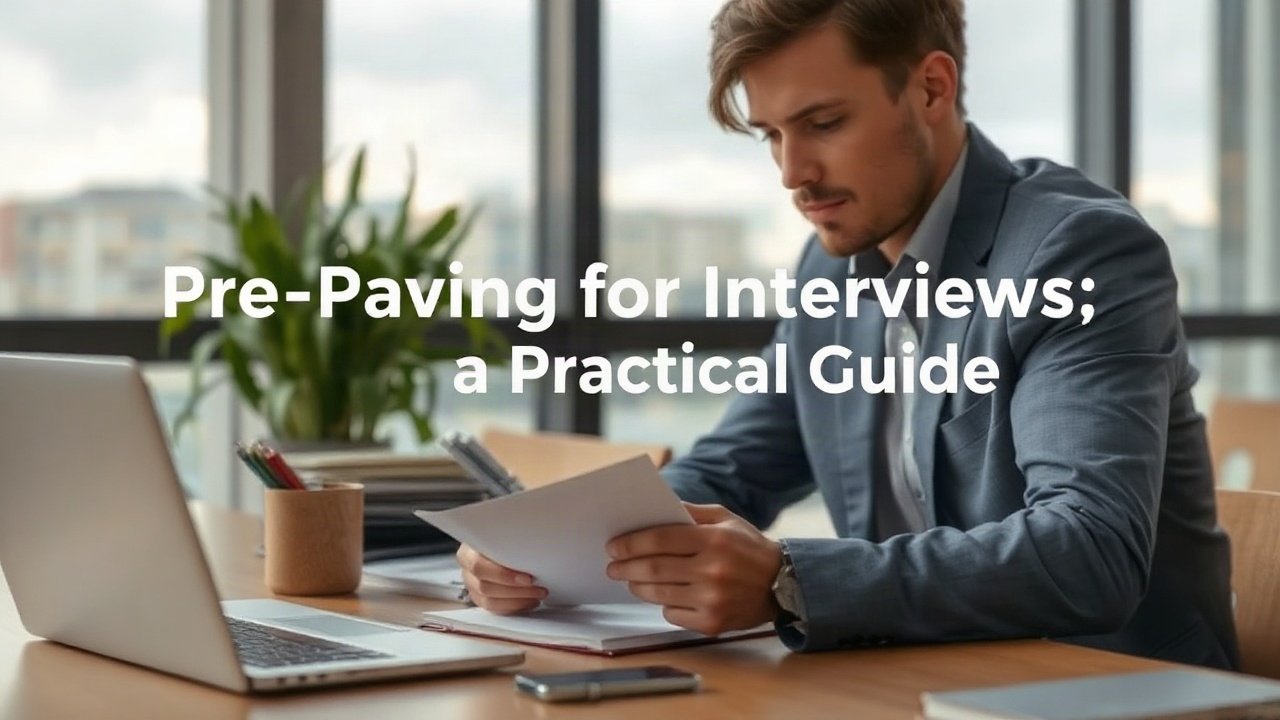
Pre-paving an interview is structured mental rehearsal: anticipate the stages, prepare evidence and decide how you will respond when nerves appear. The method becomes useful when the imagined future includes both your preferred response and a credible disruption.
Pre-pave the process, not the result
A weak version of pre-paving is a success montage: everything runs smoothly, people react exactly as hoped, and the final outcome is already secured. That may feel pleasant, but it leaves you with no plan for the moment reality differs. For Pre-Paving for Interviews: A Practical Guide, apply that boundary to the exact scenario and evidence on this page rather than treating it as a generic manifestation rule.
A stronger version asks three questions: What is likely to happen? What matters most in how I respond? What will I do if the common difficulty appears? That turns imagination into preparation. For Pre-Paving for Interviews: A Practical Guide, apply that boundary to the exact scenario and evidence on this page rather than treating it as a generic manifestation rule.
Build the scene in four moves
- Map the likely opening, evidence questions and your questions for them.
- Select three examples that prove skills instead of memorising twenty answers.
- Rehearse a pause before answering.
- Prepare a recovery line for a question you cannot answer immediately.
Keep the rehearsal short enough that you can still prepare in the real world. Five focused minutes plus practical setup is usually more useful than thirty minutes of perfect imagery. For Pre-Paving for Interviews: A Practical Guide, apply that boundary to the exact scenario and evidence on this page rather than treating it as a generic manifestation rule.
Evidence boundary
Supported/adjacent: mental rehearsal, prospective planning and implementation intentions have evidence in performance and behaviour contexts when they are tied to specific actions. For Pre-Paving for Interviews: A Practical Guide, apply that boundary to the exact scenario and evidence on this page rather than treating it as a generic manifestation rule.
Traditional belief: manifestation teaching may describe pre-paving as setting the energetic tone of a future segment so events line up more favourably.
Unsupported or unknown: there is no established evidence that imagining a smooth event causes other people, systems or chance events to cooperate.
Preparation improves readiness; it does not control the panel’s decision.
Do not rehearse every possible disaster
Contingency planning has a stopping point. Choose one or two likely disruptions, not twenty remote catastrophes. If the exercise increases anxiety, return to the minimum plan: desired conduct, first step, one backup. For Pre-Paving for Interviews: A Practical Guide, apply that boundary to the exact scenario and evidence on this page rather than treating it as a generic manifestation rule.
Pre-paving should make the event simpler to enter. If you finish with more rules than you started with, the planning has become another avoidance loop.
After the event
Review facts before meaning. What happened? What did you do? Which prepared response was useful? What would you change next time? Only after that should you interpret the experience. For Pre-Paving for Interviews: A Practical Guide, apply that boundary to the exact scenario and evidence on this page rather than treating it as a generic manifestation rule.
This order reduces hindsight storytelling. A good outcome does not prove that imagination controlled the event, and a difficult outcome does not prove that you failed to “align.”
Interview rehearsal: build an answer bank, not a success movie
The test case is intentionally narrow: a 45-minute competency interview for a role with three requirements you meet strongly and one you are still developing. In that situation the real obstacle is generic visualisation makes you picture the offer while the weak example remains unrehearsed. If the practice cannot change how you meet that point, stronger wording will not rescue it.
Try one planned run: pre-pave the opening, two strong STAR examples, one honest development answer and the moment you ask for clarification instead of bluffing. Keep the method itself bounded, then let the rest of the result come from ordinary action, other people and circumstances.
Review with this evidence set: specific examples used, pace, recovery after an unfamiliar question, and the quality of your questions at the end. You are looking for direction of travel, not a perfect score.
When the planned step is too large, do this instead: If you cannot prepare everything, prioritise evidence for the two requirements most central to the role. A fallback makes consistency more honest because it is defined before discomfort arrives.
Finish with a non-negotiable stop rule: The panel’s choice is not yours to script; preparation is the controllable output. Once that point is reached, further mental repetition is not extra preparation; it is a different behaviour and should be judged separately.
Next step
Take the next real interviews situation and write a four-line pre-pave: desired conduct, first action, one likely disruption, one response. Then complete any practical preparation the exercise reveals.