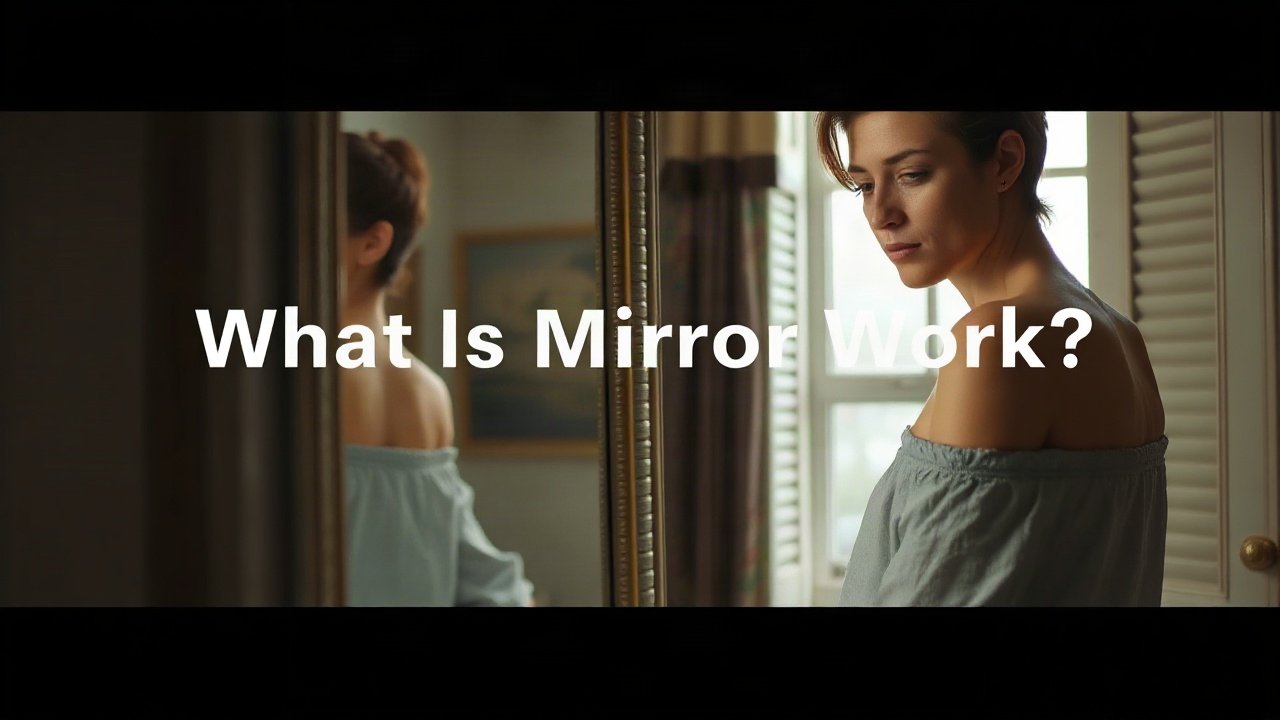
Mirror Work is a self-reflection practice in which you look at yourself in a mirror while speaking chosen statements, questions or compassionate acknowledgements. In manifestation communities it is usually presented as a way to direct attention deliberately toward a desired outcome. A grounded version keeps the exercise but removes the promise that a ritual can guarantee events outside your control.
The simplest way to understand Mirror Work is as a structured prompt: it gives your mind a specific job for a limited period. Whether it becomes useful depends less on mystical precision and more on the quality of the thought, the way you respond to doubt, and what you do afterwards.
The mirror changes attention, not reality
Looking at your own face makes self-directed language harder to ignore. That can be useful, but it can also bring up embarrassment or criticism. Start with 30–60 seconds rather than forcing a dramatic session.
You are not trying to hypnotise yourself. Notice the reaction to the sentence. If “I love everything about myself” produces instant rejection, move to “I am willing to speak to myself more fairly.”
Build from acknowledgement to action
A practical sequence is: acknowledge what is true, state a believable direction, then name one behaviour. “I am nervous about this interview. I can still prepare well. I will practise the first answer twice.”
A clean first attempt
For a simple working version, for your first attempt, keep the practice deliberately small. Define one intention in ordinary language. Choose one session rather than promising yourself a 30-day streak. When you finish, write a sentence beginning “The next thing I can actually do is…”
That last sentence prevents Mirror Work from becoming passive waiting. If there is no sensible action today, choose a deliberate non-action: wait until the agreed date, stop checking for 24 hours, or let another person have the space they requested.
What beginners often add unnecessarily
At the decision point, online versions accumulate rules quickly. You may see claims about exact clock times, colours, special frequencies, particular notebooks, perfect emotional states or restarting after a negative thought. Those extras are not required to understand the core practice.
If an extra rule makes the session easier or more enjoyable, treat it as preference. If it makes you anxious that one mistake has “ruined” the method, remove it.
One practical use case
In a real-world application, imagine that the goal is better performance at work. Rather than using this practice to demand a promotion, define the part you can influence: preparation, communication, visibility, skill or consistency. Use the method to hold that direction, then choose a behaviour that can produce information in the real world.
A useful manifestation practice does not eliminate uncertainty. It helps you operate better while uncertainty remains.
Questions people ask
Do I need to believe it completely?
For the current use case, no. Total certainty is not a prerequisite. A workable sentence is one you can engage with without spending the whole session fighting it. If necessary, use bridge language such as “I am learning…”, “I am open to…”, or “I can take the next step toward…”.
What if my attention wanders?
Return. Wandering is not evidence of resistance, sabotage or a blocked manifestation. It is a normal feature of attention. The skill is noticing and reorienting.
Should I repeat the session until I feel different?
Not automatically. Decide the dose before you begin. If one session improves clarity, stop there. Repeating primarily to obtain reassurance can turn a simple practice into a checking loop.
Can I use it for another person?
As a practical safeguard, you can reflect on the relationship you want and rehearse your own communication. You cannot establish consent or guarantee somebody else's choice through a private exercise. Where another person is involved, build the goal around reciprocity and observable behaviour.
How to measure whether it is useful
For one week, record four things after each session: clarity, tension, the next action, and whether you completed that action. Do not score the practice by coincidences.
From a behaviour-first perspective, at the end of the week, look for a pattern. If you are clearer and more consistent, keep or refine it. If you are more anxious, more superstitious or less active, shorten it or choose another method.
A sensible place for the exercise in a routine
For the current use case, this method should occupy a small part of the day. The rest belongs to relationships, work, rest, health, planning and the actions connected to your goals. You do not need to “stay in the state” every waking minute.
Use the practice when it helps you orient. Then let it go.
Next step
Try one stripped-back session with the recommended tool. Keep one intention, one bounded exercise and one controllable next move. That is enough to learn what the routine contributes for you.