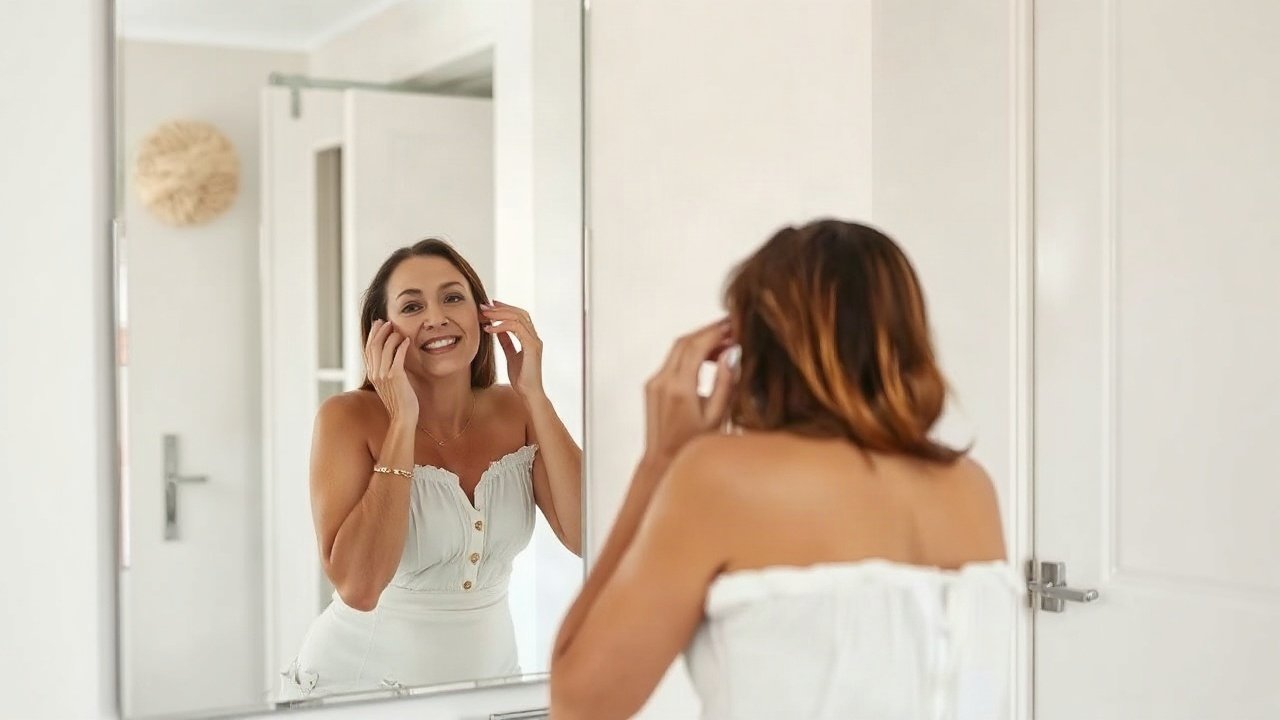
Mirror work for body image should aim for neutral, respectful self-contact—not forced admiration and not prolonged inspection. If looking in the mirror already triggers checking, comparison or distress, the practice needs a strict time limit or a non-mirror alternative.
A grounded sentence is: “This is my body today, and I can treat it with respect.” You do not have to believe that every feature is beautiful in order to stop speaking to yourself cruelly.
Change the target from appearance to relationship
Body-image mirror work becomes risky when the goal is to stare until you finally like what you see. That keeps appearance at the centre and can intensify the very monitoring you are trying to reduce.
Instead, practise the relationship you want to have with your reflection: brief contact, less judgement, neutral description and a return to ordinary life. The session succeeds when you can leave the mirror—not when you achieve a perfect feeling.
A ninety-second practice
- Set a short timer before you approach the mirror.
- Look at your whole reflection rather than repeatedly zooming attention into one disliked feature.
- Use one neutral or compassionate sentence.
- Notice any urge to check, compare or correct. Do not obey it automatically.
- When the timer ends, leave the mirror and keep the mirror contact brief, use neutral respectful language and then do one valued activity unrelated to appearance checking.
The post-mirror action is essential. It reconnects your attention with values and activities beyond appearance.
Language that is less likely to backfire
If “I love my body” feels false, do not force it. Try statements such as:
- “I do not have to solve my appearance right now.”
- “My body is more than an image.”
- “I can speak to myself without insults.”
- “I can choose clothes, movement and care without punishing myself.”
Believability matters more than positivity. A neutral statement you can use is preferable to an extreme affirmation that starts an internal argument.
Evidence and safety boundary
Adjacent evidence: self-compassion, self-talk and forms of mirror exposure are studied in psychological contexts, but they are not interchangeable with a generic manifestation ritual and should not be oversold.
Traditional belief: manifestation versions of mirror work may frame spoken statements as ways of impressing a new identity or attracting a changed external reality.
Unsupported or unknown: a mirror does not make affirmations biologically or metaphysically more powerful.
If mirror checking, avoidance, eating concerns or body distress are intense, seek qualified support rather than using this page as treatment. This page is educational and should not be used to diagnose or treat a body-image or eating disorder.
What to track instead of “Do I look better?”
Use behavioural measures: checking time, neutral self-talk, valued activities resumed and appearance-based avoidance reduced. You might also note how long you spent checking before and after the experiment.
Do not use photographs, scales or repeated appearance comparisons as the scorecard for this practice. Those measures can pull attention straight back into surveillance. The goal here is a more workable relationship with the mirror.
When to stop
Stop the exercise if it increases distress, checking, avoidance, food restriction, compensatory behaviour or the urge to repeat until you feel “right.” You are allowed to use a non-mirror self-compassion prompt instead.
If body-image distress is significantly affecting daily life, eating or safety, qualified professional support is more appropriate than pushing harder on a manifestation technique.
Use the Mirror Practice Builder
The Mirror Practice Builder can help you choose a neutral statement, set a time limit and name the valued action that comes afterwards. Keep the plan deliberately small.
A concrete body image test case
A practical test begins with getting dressed before leaving the house, when one glance in the mirror can easily turn into repeated checking from several angles. The difficulty to watch is trying to solve discomfort by looking longer and evaluating more details. Keeping the test this narrow prevents a single outcome from being used as proof for every claim attached to Mirror Work.
Use a small six-item sheet rather than a mood score:
- Whole reflection: record one concrete fact about it before interpreting the result.
- Neutral phrase: record one concrete fact about it before interpreting the result.
- Checking time: record one concrete fact about it before interpreting the result.
- Clothes choice: decide in advance what useful movement would look like.
- Valued activity: decide in advance what useful movement would look like.
- Mirror exit: decide in advance what useful movement would look like.
After the session, use one brief whole-body look, leave the mirror on time and continue with the planned activity. Keep leave the mirror when the timer ends and return to ordinary activity as the operating rule. This makes whole reflection, neutral phrase and checking time more informative than coincidences or post-hoc stories.
This field test is deliberately narrower than the headline title. That is a quality feature. It gives the page a distinct Mirror Work × body image answer instead of changing only the noun while repeating the same advice.
Next step
Set one brief mirror session with a neutral phrase, then leave and do the non-appearance action you chose. Judge the experiment by whether checking decreases and ordinary life gets more space—not by whether you manage to feel positive about every feature.