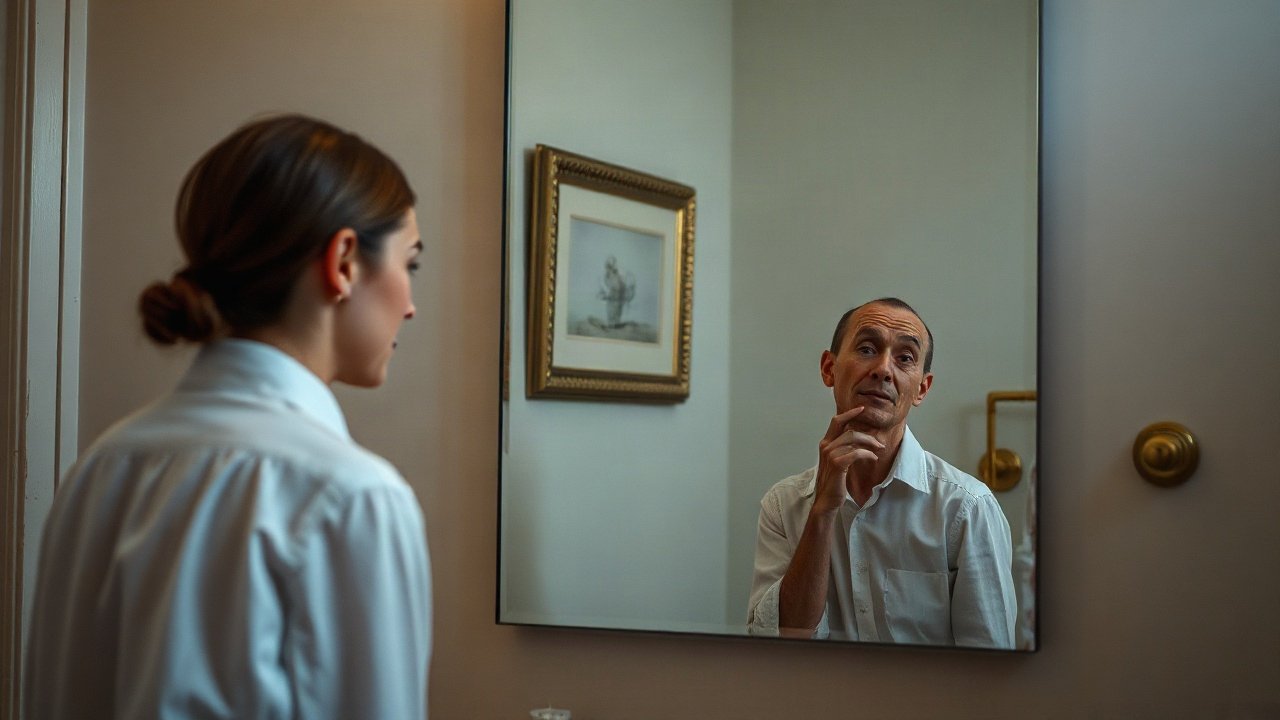
What a useful mirror example contains
A strong Mirror Work example makes the method’s real job visible. Here, that job is to use your reflection as an optional cue for direct self-talk, compassionate language or rehearsal that can later be tested away from the mirror. Copy the structure, not the exact sentence; the point is to understand why an example is useful.
Confidence example
Look briefly at your reflection and say, “I can prepare well and speak one sentence at a time.” Then practise the actual opening sentence you need.
Self-compassion example
Use, “This is difficult and I can still take care of the next step.” The mirror is a cue for directness, not a demand to feel positive.
Boundary example
Practise, “No, I cannot commit to that.” The useful test is whether the wording becomes easier to use outside the mirror.
When the wording is too extreme
A weak version forces extreme praise that you immediately reject. The gap between the sentence and your current belief may turn the mirror into a confrontation.
When the mirror becomes a test
An overcomplicated version demands long eye contact, dozens of lines and an emotional breakthrough. You may shorten the practice, soften your gaze or skip the mirror entirely.
Make the sentence believable
Repair the weak version by removing anything Mirror Work cannot control and adding one practical function: a decision, sentence, behavioural cue, review point or action. A repaired example usually feels less dramatic and more usable.
Move the practice outside the mirror
After using an example, look for direct evidence relevant to the method. Whether the wording becomes more believable and behaviourally useful is more informative than signs or emotional intensity. If the example does not improve the thing the method is designed to help, change the example rather than adding more ritual.
Quality check
Ask four questions: Is the wording clear? Does it fit the mechanics of Mirror Work? Does it respect facts and other people’s autonomy? Can I name what I will do or review after the exercise? If yes, the example is probably specific enough.
A full direct self-talk rehearsal case
In an examples article, this scenario is useful because it shows the mechanics of Mirror Work without asking the reader to copy the life details.
Why this example is diagnostic
The example tells you what Mirror Work is for and what it is not for. It contains a practical bridge, a real-world test and a stopping point. That makes it more useful than an emotionally dramatic example that cannot change a decision.
A second quality test
If eye contact or the reflection itself is activating, change the format. Audio notes, written self-talk or ordinary rehearsal can perform the same practical job without forcing exposure. Then ask whether the example still respects facts, safety and other people’s autonomy. If not, rewrite the example around your own behaviour and evidence.
Three mirror sentences that can leave the mirror
Confidence: “I can prepare and speak one sentence at a time.” Boundary: “No is a complete decision even when I explain briefly.” Self-compassion: “This is difficult and I can still take care of the next step.” Each line can be rehearsed elsewhere; the mirror is not the source of its validity.
What not to copy from examples
Copy the decision logic of Mirror Work, not the exact life details. Change the goal, wording and action to fit your situation. If an example encourages denial of facts, control of another person, sleep loss or avoidance of a real task, it is a poor example even if it sounds inspirational.
One more Mirror Work example test
Imagine changing the goal in Mirror Work Examples: Good, Weak and Overcomplicated to a completely different area of life. The example should still preserve the same method mechanics while the wording, action and evidence change. That portability is a quality check: it shows you understand Mirror Work rather than memorising a sentence. If the example only works because of a special symbol, exact person or lucky timing rule, simplify it until the practical function is obvious.
Bottom line
Good Mirror Work examples are specific enough to guide a session and ordinary enough to survive contact with reality. If mirror exposure is distressing or linked to body-image or trauma concerns, use another form of self-talk or seek appropriate support rather than forcing the exercise. Prefer examples you can understand, use and stop.