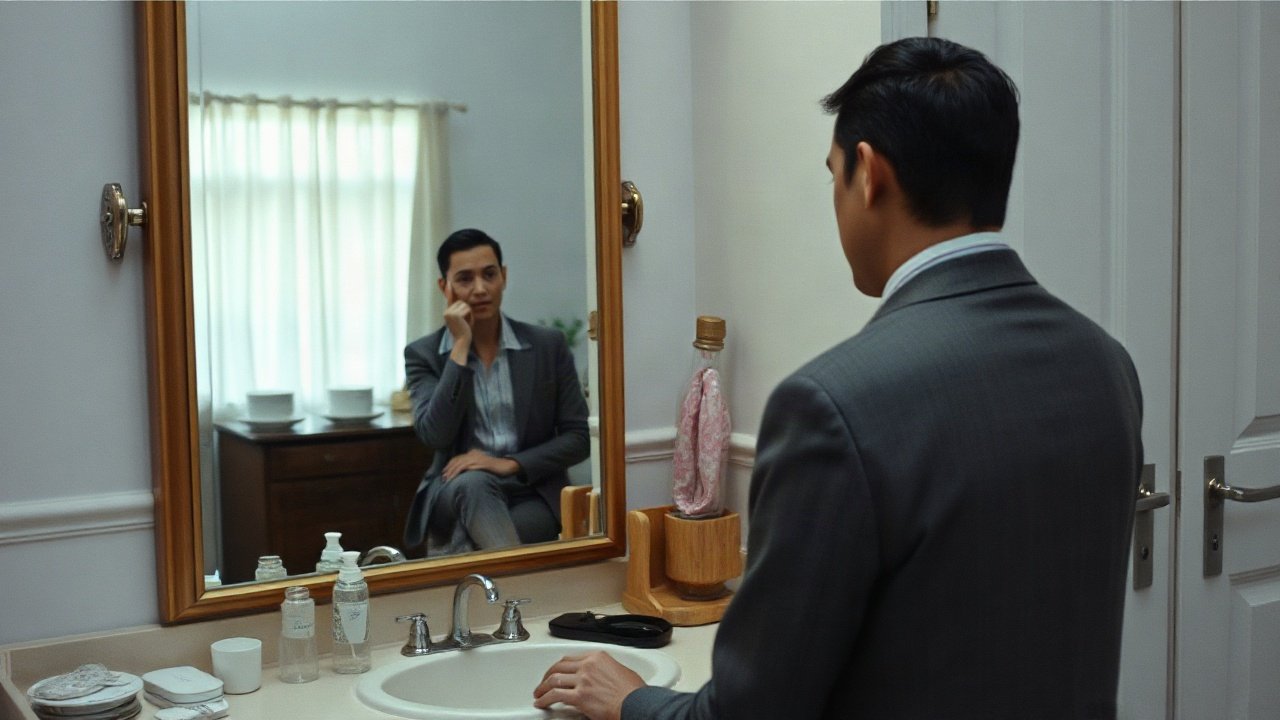
Mirror work can be gentle self-reflection, but the mirror can also make self-consciousness stronger. The method should be adapted to your response rather than treated as a test of courage. You do not have to stare into your own eyes, repeat grand claims or keep going when the exercise reliably makes you feel worse.
Mistake: forcing eye contact
Direct eye contact with your reflection can feel intense. Look at your eyebrows, cheek, shoulder line or even a point beside the mirror if that is easier. The purpose is self-directed language, not winning a staring contest.
Mistake: choosing statements that trigger immediate rejection
“I am completely fearless and everyone adores me” may create a stronger argument than the thought you started with. Use language that is credible enough to work with: “I can speak to myself more fairly,” or “I can prepare for this conversation.”
Mistake: turning appearance into the score
Mirror work is not a beauty inspection. Do not search your face, body or expression for evidence that the practice is working. If appearance concerns become stronger, cover or leave the mirror and use written or spoken self-compassion instead.
Mistake: doing long sessions because short ones feel weak
One or two sentences can be enough. Longer exposure is not automatically better. A short practice that ends before shame or rumination escalates is more sustainable than twenty minutes of forced intensity.
Mistake: using the mirror instead of changing behaviour
If your statement is about confidence, choose one behaviour that fits: ask a question, prepare your notes or speak once in the meeting. If it is about self-respect, practise a boundary or stop a piece of unnecessary self-criticism. Behaviour is the better test.
Try a mirror-free control condition
Use the same sentence on alternating days. One day, say it in front of the mirror. On another, say it while looking at a notebook. Rate believability and distress. If the mirror adds no benefit, there is no reason to keep it.
Reduce visual intensity deliberately
Stand farther back, use softer lighting or shorten the session. These are not failures. They are ways of adjusting the stimulus so the practice remains tolerable. The reflective surface is optional equipment, not the essence of the exercise.
Watch for shame spirals
If a statement produces a stream of insults or harsh comparisons, stop. Ground yourself in something neutral and specific. Persistent distress is a reason to choose another practice or seek appropriate support, not a reason to intensify the mirror session.
Keep other people out of the mirror
Do not use mirror work to rehearse how someone else must see you or to demand a particular reaction from them. Keep the focus on your own language, choices and standards.
Boundary
Mirror work can influence your own self-talk or behaviour. It cannot determine another person’s attraction, guarantee an outcome or override current facts. Those stronger claims require evidence the practice does not provide.
Separate self-talk from appearance checking
If you catch yourself scanning skin, weight, expression or symmetry while doing the exercise, cover part of the mirror or move to a position where your reflection is less detailed. The goal is to work with language, not to turn the session into visual inspection. This separation is especially useful if mirrors already trigger comparison.
Use evidence statements instead of declarations
Try sentences such as “I handled that meeting better than last month” or “I kept the boundary I set.” Evidence-based statements are easier to believe because they refer to something that happened. They can build self-trust without requiring you to repeat a sweeping identity claim that your mind immediately rejects.
End on a neutral sentence when needed
You do not have to finish with a triumphant affirmation. “I am done for today,” “I can be decent to myself,” or “I will handle the next step later” can be enough. A neutral close makes it easier to stop without demanding a dramatic emotional shift.
A practical session should leave you with less self-surveillance, not more. That is a useful stopping test.
Bottom line
Use mirror work only if the mirror helps rather than harms. Keep statements believable, sessions short and behaviour outside the mirror central. If a non-mirror version is kinder and equally useful, use that instead.