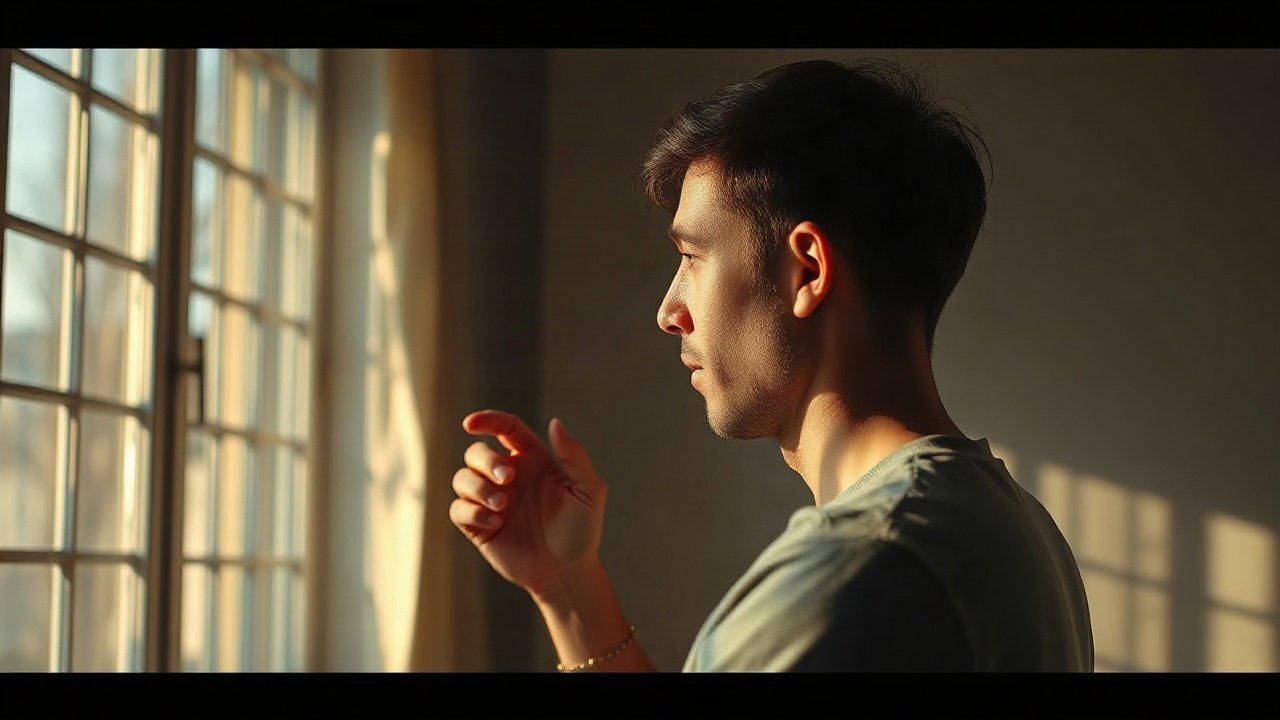
First-person imagining means experiencing an imaginal scene from your own point of view rather than watching yourself like a character on a screen. In Neville Goddard material, participatory imagination is often favoured because the aim is to experience from the fulfilled state, not merely observe an attractive picture of it.
What first-person perspective looks like
Imagine receiving good news. In third person, you might see yourself standing in the room, smiling, as if a camera were filming you. In first person, you might see the phone in your hand, hear the other person’s voice and feel your feet on the floor. The imagined “camera” is behind your own eyes.
That is the technique in ordinary language. It does not require cinema-level imagery.
Why perspective mattered in Neville’s system
Neville’s wider teaching emphasises thinking from a state rather than thinking about it. First-person scenes naturally support that distinction because the scene is organised around your participation. The fulfilled condition is experienced as the current point of view.
Within his metaphysics, the imaginal act is treated as causally creative. The choice of perspective therefore belongs to more than mental rehearsal in the original doctrine.
Perspective is not a magic setting
Modern tutorials sometimes turn first-person viewpoint into a technical law: if you accidentally see yourself from outside, the scene supposedly will not “impress the subconscious.” That is an unnecessary escalation.
People naturally switch imagery perspectives. Some have vivid visual imagery; some have weak visual imagery or aphantasia. A useful exercise can use sound, touch, inner speech, spatial awareness or simple conceptual knowing. The practice should fit the person rather than the person failing a visualisation exam.
A grounded use: mental rehearsal
First-person imagery can be useful because it resembles the cues you will encounter while acting. Before a presentation, imagine looking at the first slide, hearing your opening line and feeling your hand on the clicker. Then rehearse the actual opening aloud.
The value is preparation. The scene can prime attention and reduce novelty. It does not guarantee the audience’s response.
Example: difficult conversation
Suppose you need to set a boundary with a client. Instead of imagining a perfect final outcome, rehearse the part you control. From first person, hear yourself say: I can continue the project within the agreed scope; extra work needs a revised quote. Imagine pausing rather than filling the silence. Then write the real message or schedule the call.
If the client reacts badly, that response is evidence. The exercise prepared your side of the conversation; it did not script theirs.
What if you keep seeing yourself from outside?
Nothing catastrophic has happened. You can gently shift perspective if first person helps, or use the external view if it supports learning. Athletes and performers may use both internal and external imagery for different purposes. The manifestation claim does not become more evidenced because one camera angle feels more immersive.
A useful rule is functional: choose the perspective that makes the next real action clearer.
Sensory detail is optional, not a purity test
Some readers can create detailed images; others mainly experience words or bodily sense. If the target is a job interview, one remembered sentence—Tell me about a time you solved a difficult problem—may be enough to trigger useful rehearsal. You do not need to construct the carpet, lighting and interviewer’s face.
Excessive detail can even distract from the behaviour you are trying to practise.
Use the Neville Practice Selector
Use the Neville Practice Selector when you want to decide between first-person imagery, inner conversation, SATS, revision or another method. Choose by function: rehearsal, clarification, emotional settling or identity work.
First person is a tool, not a test of talent
A person who mainly thinks in words can still practise from a first-person standpoint. They can rehearse the sentence they will say, the choice they will make or the sequence of steps they will perform. The defining feature is participation, not visual sharpness. That makes the method usable for a much wider range of cognitive styles than many online tutorials imply.
Bottom line
First-person imagining is simply participatory imagery: you experience the scene from your own viewpoint. It fits Neville’s emphasis on thinking from a state. A grounded reader can use it as rehearsal or clarification without treating perspective, vividness or sensory detail as a supernatural technical requirement.