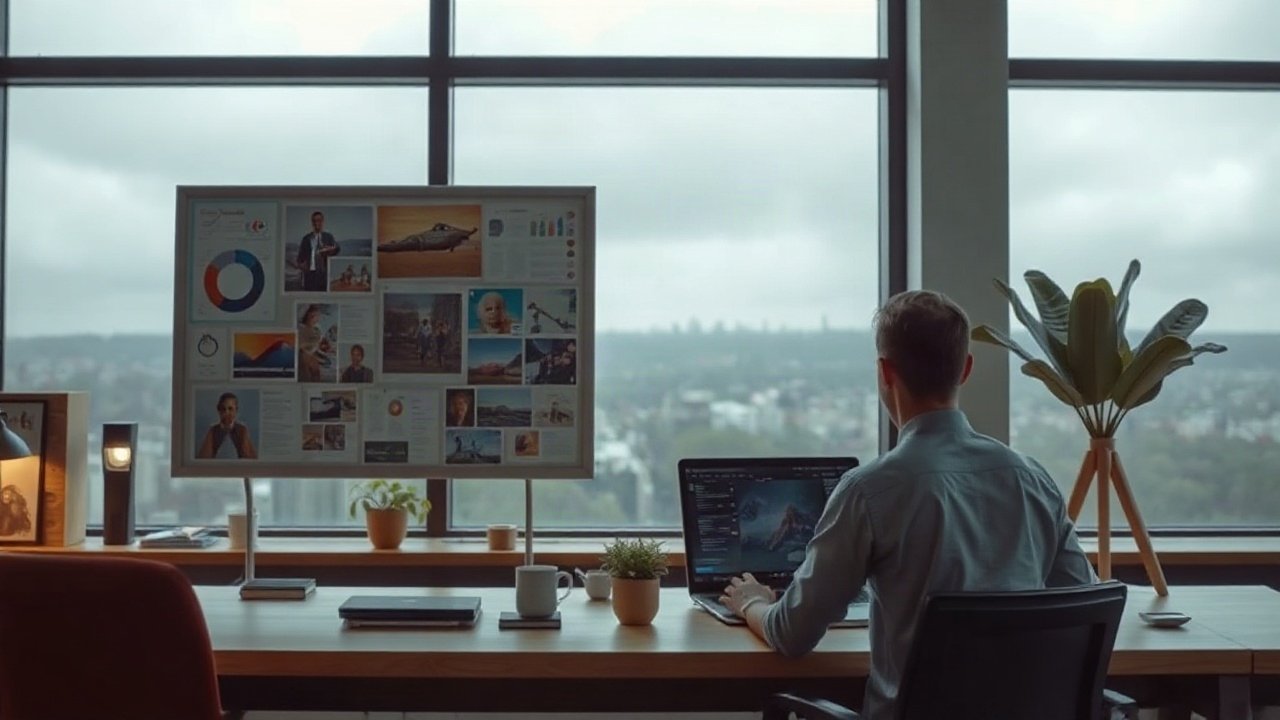
A vision board is an external collection of visual cues you can return to; visualization is an internal mental exercise in which you deliberately imagine a scene, process or outcome. Both use imagery, but they solve different problems. A board keeps priorities visible across time. Visualization lets you rehearse or inspect one situation from the inside.
The distinction in one table
| Question | Vision board | Visualization | | --- | --- | --- | | Where does the image live? | On a physical or digital board | In deliberate mental imagery | | Best at | Ongoing reminders and seeing several priorities together | Rehearsing one scene, process or response | | Time pattern | Built occasionally, viewed briefly | Used in short sessions | | Main weakness | Images can be attractive but vague | Imagery can become fantasy without action | | Useful tool | Vision Board Builder | Visualization Planner |
Choose a board when visibility is the problem
A board earns its place when you already have meaningful goals but they disappear under daily noise. Seeing a few carefully chosen images can bring the priorities back into view without requiring a long journaling session.
The important word is chosen. A board filled with luxury pictures, borrowed aspirations and generic motivational quotes can create more comparison than clarity. Each important image should be translatable into a sentence you genuinely own. A photograph of a quiet desk might mean uninterrupted creative time, not a particular brand of furniture. A railway map might represent local travel rather than “freedom” in the abstract.
If you cannot say what an image means and what behaviour connects to it, the board is decoration.
Choose visualization when rehearsal is the problem
Visualization is more useful when you need to work through one experience: opening a presentation, beginning a difficult conversation, performing a skill, or seeing yourself start a task you keep avoiding. Process imagery can make the sequence more concrete before you act.
That does not mean imagery causes the external result. The grounded use is rehearsal, attention and clarification. A person visualizing an interview still needs evidence, preparation and answers. A person visualizing a race still needs training.
Visualization also does not have to be vivid or cinematic. People with weak voluntary imagery or aphantasia can use words, spatial structure, sound, touch or a simple written run-through instead.
Same goal, two very different uses
Suppose you want a calmer working life.
A vision board might contain a small number of cues: an uncluttered calendar, daylight walking, a focused desk and a photo representing meaningful work. Together they reveal the pattern: you value autonomy, fewer interruptions and room to think.
Visualization would take one piece of that pattern and rehearse it. You might imagine closing email, opening the priority document, working for twenty minutes and then checking messages at the planned time. The imagined sequence is useful because it points directly at a behaviour.
The board answers what do I want to keep visible? Visualization answers what situation do I want to mentally rehearse?
Evidence boundary
Adjacent evidence: visual cues can affect attention and reminders, while mental imagery has research traditions in performance and rehearsal contexts. Effects depend on the task and how imagery is used.
Traditional belief: manifestation communities may describe both practices as ways of “attracting” a matching reality.
Unsupported or unknown: there is no established evidence that placing an image on a board or repeatedly visualizing it causes a desired external event through a law of attraction.
That distinction lets you use either technique without pretending the strongest claim has been proved.
A decision test
Use a board if you keep forgetting the larger direction. Use visualization if you know the direction but need to rehearse a specific process. If neither problem exists, you may not need either method.
You can also combine them with almost no extra ritual: choose one image from the board, translate it into one behaviour, then visualize the first thirty seconds of doing that behaviour. Stop there and act.
Watch for the different traps
With boards, the danger is collecting idealized images without defining what they mean, overspending to imitate them, or letting the board become a catalogue of other people's lives.
With visualization, the danger is rehearsing the pleasurable ending while repeatedly avoiding the preparation. More vivid imagery is not automatically more useful.
For either method, judge the practice by a controllable signal: did it clarify the goal, improve preparation, prompt a useful action or help you notice a trade-off? Do not use coincidences as the scorecard.
Next step
Use the Manifestation Method Finder if you are unsure which format fits. If visual reminders are the need, build a small board with meanings you can explain. If rehearsal is the need, choose one short process scene and connect it to the next real action.