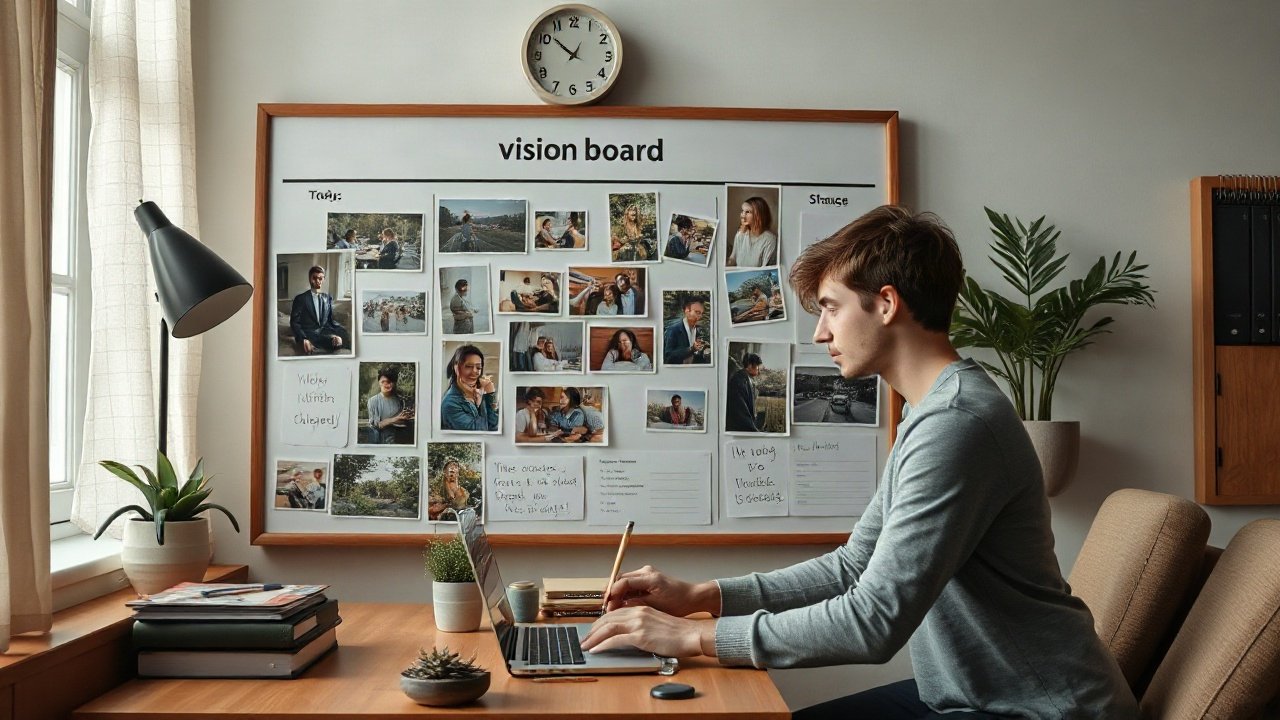
No. A vision board is a visual aid, not a necessary manifestation mechanism.
There is a difference between a personally meaningful ritual and a requirement. Keeping that distinction clear protects both agency and evidence.
Start with the function
Images can make priorities salient and can help some people remember what they are working toward, but a board cannot substitute for decisions, skills, resources or reciprocal action.
The point is not to remove meaning from the practice. It is to stop meaning from replacing measurement when measurement is available.
The useful version
Use one if images help you compare options, remember values or keep a long-term direction visible without becoming obsessive. Before repeating the practice, ask what changed because of it.
Useful outputs include a clearer criterion, a calmer response, a decision, a rehearsal, a plan or a completed action.
The failure mode
It becomes unhelpful when you confuse seeing a picture repeatedly with reducing the real constraints between you and the outcome. A warning sign is temporary relief followed by a stronger need to repeat the ritual because uncertainty has returned.
A practical replacement
For every image, attach a practical question: what does this represent, what is controllable, and what evidence would show movement? Put the result somewhere observable: a calendar entry, checklist, decision rule, progress measure or conversation you can actually complete.
A concrete scenario
A dream-home board is more useful when it leads to a shortlist of non-negotiables, budget limits and locations than when it is treated as proof that a particular property must appear.
The important part is the causal chain. The practice may influence preparation or behaviour; the external result still depends on the system around it.
Reality boundary
People with weak visual imagery or no interest in pictures lose nothing by using words, checklists or a decision matrix instead. Money, health, safety, employment and relationships all contain consequences or other people's choices that no inner practice can simply erase.
What to measure
Use three buckets: helpful, neutral, and costly. Helpful means the practice improves clarity or action; neutral means it is pleasant but changes little; costly means it increases fear, avoidance or compulsion. Refresh the board when your criteria change. A tool should follow the goal; the goal should not become hostage to old pictures.
A seven-day experiment
Set one review date seven days from now. Between now and then, follow this practical step: For every image, attach a practical question: what does this represent, what is controllable, and what evidence would show movement? Avoid repeatedly asking whether the method is 'working'. At review, look for behaviour completed, information gained, a constraint reduced or a formal stage advanced. If the only change is temporary reassurance followed by more checking, simplify the practice instead of intensifying it.
A two-minute audit
Turn Do you need a vision board? into a falsifiable test. Name one sign of benefit, one sign of wasted effort, and the date you will review both.
Then add: what I can influence next and what evidence will make me review the plan. This keeps the manifestation technique in proportion to the larger strategy.
Bottom line
The goal is not perfect technique. The goal is better orientation, better behaviour and honest adjustment when evidence changes.
No journal, phrase, tense, mood, visual image or ritual deserves more authority than the evidence and values relevant to the actual goal.
A useful threshold for keeping or dropping the practice
Keep the practice behind Do you need a vision board? when it creates a repeatable benefit you can name. Images can make priorities salient and can help some people remember what they are working toward, but a board cannot substitute for decisions, skills, resources or reciprocal action. A benefit might be better preparation, less avoidance, a clearer criterion or a completed next step. “It made me feel certain for twenty minutes” is weaker evidence if uncertainty immediately sends you back to repeat the ritual.
Also keep the boundary visible: People with weak visual imagery or no interest in pictures lose nothing by using words, checklists or a decision matrix instead. A technique that asks you to ignore that limit has stopped being a support tool and started competing with reality-based judgment.